Developmental Malformations
Cerebro-oculo-facio-skeletal syndrome
Apr. 24, 2026
MedLink, LLC
3525 Del Mar Heights Rd, Ste 304
San Diego, CA 92130-2122
Toll Free (U.S. + Canada): 800-452-2400
US Number: +1-619-640-4660
Support: service@medlink.com
Editor: editor@medlink.com
ISSN: 2831-9125
Toll Free (U.S. + Canada): 800-452-2400
US Number: +1-619-640-4660
Support: service@medlink.com
Editor: editor@medlink.com
ISSN: 2831-9125
Nearly 3,000 illustrations, including video clips of neurologic disorders.
Every article is reviewed by our esteemed Editorial Board for accuracy and currency.
Full spectrum of neurology in 1,200 comprehensive articles.
Listen to MedLink on the go with Audio versions of each article.
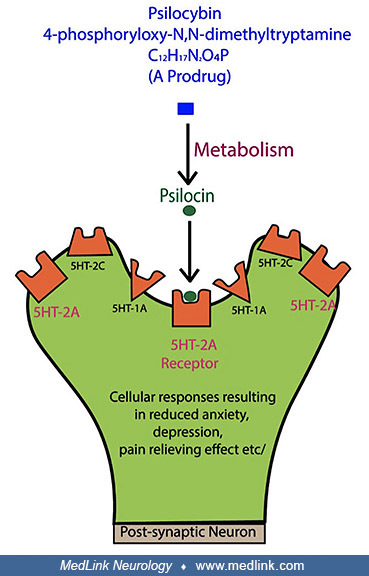
When psilocybin is ingested, it is metabolized to psilocin, which interacts with serotonin (5-HT) receptors, especially the 5-HT2A subtype. These receptors are concentrated in key brain regions, such as the prefrontal cortex, playing a major role in regulating mood, anxiety, and emotional states. Although the general effects of psilocin on these receptors are known to influence perception and emotional processing, the detailed molecular mechanisms behind these changes remain incompletely understood. (From: Adeyinka D, Forsyth D, Currie S, Faraone N. Neurobiology of psilocybin: a comprehensive overview and comparative analysis of experimental models. Front Syst Neurosci 2025;19:1585367. Creative Commons Attribution 4.0 International [CC BY 4.0] license, creativecommons.org/licenses/by/4.0.)