Neuropharmacology & Neurotherapeutics
Drug-induced disturbances of smell and taste
Dec. 02, 2025
MedLink, LLC
3525 Del Mar Heights Rd, Ste 304
San Diego, CA 92130-2122
Toll Free (U.S. + Canada): 800-452-2400
US Number: +1-619-640-4660
Support: service@medlink.com
Editor: editor@medlink.com
ISSN: 2831-9125
Toll Free (U.S. + Canada): 800-452-2400
US Number: +1-619-640-4660
Support: service@medlink.com
Editor: editor@medlink.com
ISSN: 2831-9125
Nearly 3,000 illustrations, including video clips of neurologic disorders.
Every article is reviewed by our esteemed Editorial Board for accuracy and currency.
Full spectrum of neurology in 1,200 comprehensive articles.
Listen to MedLink on the go with Audio versions of each article.
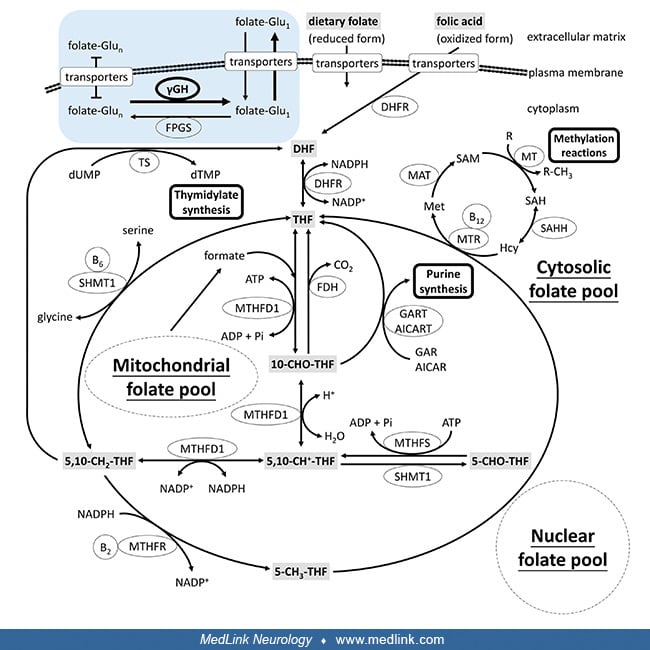
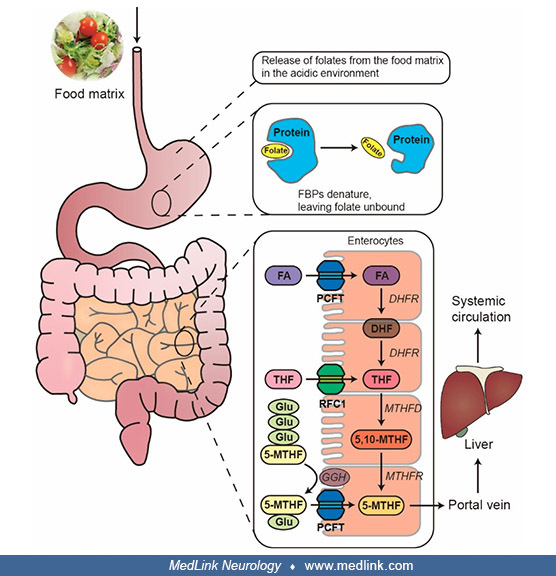
Once the food matrix enters the stomach via the esophagus, folates are liberated from the food matrix in the presence of hydrochloric acid. For example, some folate-binding proteins (FBPs) are denatured during gastric digestion, allowing the release of bound folates. In the small intestine, FA and tetrahydrofolate (THF) are transported across the cell membranes of enterocytes via two types of folate transporters: the proton-coupled folate transporter (PCFT) and the reduced folate carrier (RFC1). Polyglutamates are deconjugated into monoglutamates with the help of γ-glutamylhydrolase (GGH), located on the brush border of the enterocytes. All absorbed folate vitamers are converted to 5-MTHF in the enterocytes and exported to the liver via the portal vein. The folates are then involved in the systemic circulation and delivered to various cells, where they participate in different physiological pathways.
Other abbreviations: DHF, dihydrofolate; DHFR, dihydrofolate reductase; Glu, glutamate; MTHFD, methylenetetrahydrofolate dehydrogenase; MTHFR, methylenetetrahydrofolate reductase; 5,10-MTHF, 5,10-methylenetetrahydrofolate.
(From: Li J, Duan H, Ramaswamy H, Wang C. A comprehensive review of fortification, bioavailability, and health benefits of folate. Int J Mol Sci 2025;26[16]:7703. Creative Commons Attribution 4.0 International [CC BY 4.0] license, creativecommons.org/licenses/by/4.0.)